Schedule
Abatan River Community Life Tour: 9:00am - 5:00pm Amazing Firefly Tour: 6:30pm - 8:30pm
Entrance
Rates
75Php
Adult50Php
Children, Students, Faculty, Senior Citizens, and PWDs.
Schedule
Entrance Rates
75Php
Adult50Php
Children, Students, Faculty, Senior Citizens, and PWDs. (Must present valid ID upon entry)
It’s been four years since the October 15, 2013, 7.2-magnitude earthquake struck Bohol, and I, together with other members of print an online media, were back to check on the current state of this island-province. Our home for our three-day sojourn was to be the Class “AAA” Panglao Bluewater Resort, staying at some of their 54 elegantly appointed, spacious, very Zen and modern air-conditioned guest rooms.
As it was still early, we boarded a van and started with our resort-sponsored Tagbilaran City tour with local guide Fritze Mae Zamora, visiting the Commonwealth-era Balili Heritage House (now adaptively reused as a lodging house), as well as a number of heritage houses found in Sitio Ubos (Lower Town), the oldest district of the city.
We also visited the heavily renovated Cathedral of Saint Joseph the Worker and the President Carlos P. Garcia Heritage House (which formerly housed the Bohol Provincial Museum).
After our city tour, we were then driven 18 kilomters (km) outside the city, to the Loboc Tourism Complex, where floating restaurants are docked. Here, we were all whisked to the waiting double-hulled floating restaurant of Village Floating Resto and Cruises. During our 2-km cruise to Busay (or Tontonan) Waterfalls, we dined on a delicious buffet prepared by Ma. Christina T. Sultan, while listening to a local band singing bossa nova songs.
Back on the mainland, we again proceeded on our countryside tour, this time to check on the state of a number of Bohol churches invariably damaged during the 2013 earthquake. Their ongoing restoration is, by itself, an attraction to tourists.
The Church of the Immaculate Conception of the Virgin Mary in Baclayon, its façade now restored (under the National Historical Commission of the Philippines), will reopen on December 8, the town’s fiesta.
The Church of the Holy Trinity (its portico façade and separate bell tower have been restored) in Loay, the Church of Saint Monica in Albuquerque and the Church of Saint Nicholas of Tolentine in Dimiao are still undergoing repair. The Church of Saint Peter the Apostle (a National Cultural Treasure), as well as its separate bell tower, are still in ruins.
We also visited the undamaged Church of Our Lady of Mount Carmel, as well as its separate hilltop bell tower (also destroyed by the earthquake but now faithfully reconstructed), both in Balilihan, and the Spanish-era Ermita Ruins beside Dimiao’s Church. The ceilings of the churches of Balilihan and Loay feature lovely murals done by Cebuano artist Ray Francia, the “Michaelangelo of Cebu.” Back at the resort, we were treated to a boodle dinner of grilled favorites along the white-sand beach.
The next day, after a buffet breakfast at the resort’s Aplaya Restaurant, we boarded a motorized outrigger boat for our island-hopping tour. A 15- to 20-minute boat ride brought us to Virgin Island (also known as Pungtud or Pontod Island), a 1-hectare (during low tide) stretch of white sandbar with small patches of mangroves, grass and coconut trees, and surrounded by shallow waters and seagrass. Here, vendors sell pearls (in its natural state, or mounted as earrings, bracelets or necklaces) or fresh, edible abalone, sea cucumber and sea urchins (swaki).
We next made a landfall at the flat, barren 21-hectare Balicasag Island, where we were to have lunch of grilled specialties. The island is ringed by a pristine sandy shell, coraline beach, but most or the tourists who visit here come primarily for the scuba diving and snorkeling. On the southwest side of the island is the 1.5-hectare Balicasag Island Dive Resort and right in front of the resort is a 3.44-hectare marine sanctuary. Before lunch, Jerni, Isabel, Tito and I boarded small boats that brought us to a nearby offshore coral garden. Here, we snorkeled its beautiful underwater scenery.
Back at the resort, we all indulged on a merienda of delicious halo-halo with a different twist, its ingredients served inside a coconut. Later in the evening, first-timers Isabel and Tito joined the Abatan River Firefly Watching Tour, a memorable, magical and surreal encounter with lightning bugs moving, in the pitch black darkness of the night, like blinking and synchronized waves among pagatpat (mangroves). Our third and last day was our rest day. While the others enjoyed the pool, I just savored a hot soak in my free-standing tub and it was with deep regret that I had to leave it for my return trip back to Manila.
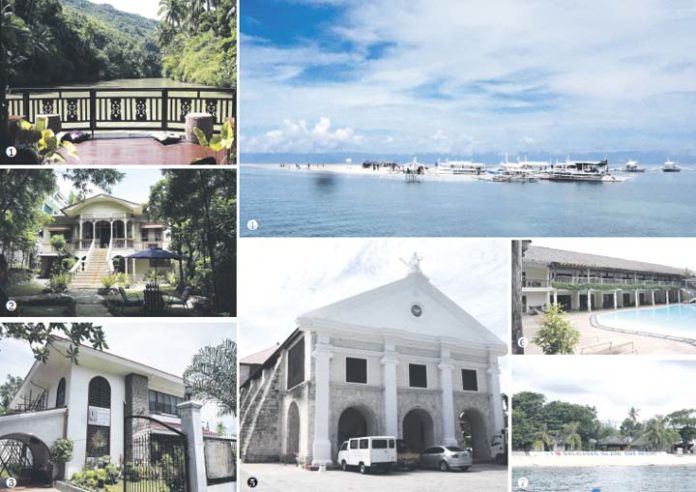
In Photo: 1 An idyllic cruise along Loboc River
2 Balili Heritage House, an example of adaptive reuse
3 The Carlos P. Garcia Heritage House
4 Virgin Island
5 The now restored portico façade of Dimiao’s Church
6 The Class “AAA” Panglao Bluewater Resort
7 Balicasag Island
Source: https://businessmirror.com.ph/2017/10/25/behold-bohol/